Forthcoming book · Springer
Deep Learning for Energy Forecasting
From RNNs to Transformers: how to build, evaluate and deploy forecasters for energy time series.
Publisher page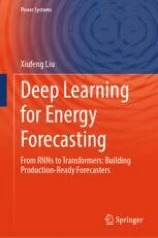
Technical University of Denmark
Senior Researcher · DTU Management
I develop machine learning methods and data systems for energy forecasting, anomaly detection, and operational decisions in buildings, power grids, and urban districts.

Forthcoming book · Springer
From RNNs to Transformers: how to build, evaluate and deploy forecasters for energy time series.
Publisher page
Interactive research software
Explore how solar generation, battery storage and demand-side management change a district’s energy system.
Open demo
Open-source research software
A modular PyTorch framework for forecasting and imputation with sparse or irregular time series from multiple sources.
My work starts with a practical question: how can energy operators make better decisions when data are incomplete, distributed across sites, or changing over time?
For the complete record, see DTU Orbit or Google Scholar.
Best Paper Award · EI.A 2026
Energy Informatics Academy Conference (EI.A 2026) · Springer LNCS 16981, pp. 3–19 · DOI
IEEE Transactions on Smart Grid · Accepted / in press · DOI
Engineering Applications of Artificial Intelligence · 182, 115920 · DOI
Applied Energy · 407, 127378 · DOI
Proceedings of AAAI 2026 · 24945–24953 · DOI
NeurIPS 2025 Datasets & Benchmarks Track. Resources: Code, Dataset DOI.
NeurIPS 2025. CC BY 4.0.
arXiv preprint arXiv:2508.18891
Applied Energy, 378, 124789
Neural Networks, 184, 107022
Neural Networks, 107887
Energy, 318, 134721
IEEE Transactions on Knowledge and Data Engineering
Applied Energy, 357, 122502
Applied Soft Computing, 154, 111362
Journal of Intelligent Manufacturing, 34(8), 3277-3304
A browser-based simulator for exploring district energy scenarios, including a baseline, higher solar photovoltaic generation, battery storage, and demand-side management. The Twin Builder lets users configure their own district model.
Led by Linköping University, the project studies how social housing can adopt low-carbon energy systems while protecting affordability and preventing rent-driven displacement.
Combines multimodal building data with optimisation to assess where photovoltaics can be placed and how they can work with other building energy systems.
Develops and tests interoperable tools for coordinating local renewable generation, storage and demand flexibility.
Co-develops planning methods and modelling tools with partners in the African and European Unions.
Studied how heterogeneous data and distributed learning can support renewable generation forecasts.
Explored how data infrastructure can support cross-border coordination in energy and mobility.
pyFAST for time-series modelling, SEGSys for energy-use segmentation, and SMAS for smart-meter analytics.
Spring 2027 · MSc thesis topic
Develop and compare forecasting models under changes in weather, prices and demand. Possible directions include feature attribution, uncertainty quantification, and seasonal robustness.
I work with students to define a feasible research question, set milestones, and document methods and results so they can be reproduced.
I received my PhD in computer science from Aalborg University. Before joining DTU, I held research appointments at the University of Waterloo, IBM Canada, and Åbo Akademi University.
Included in the top 2% of the Artificial Intelligence & Image Processing subfield for 2025 single-year citation impact in Ioannidis’s standardized citation indicators database (2026 release).
Editorial and peer-review service across energy systems, data management, and applied machine learning.
Xiufeng Liu · xiuli@dtu.dk
Department of Technology, Management and Economics
Technical University of Denmark
Produktionstorvet, Building 424, Room 006
2800 Kongens Lyngby, Denmark